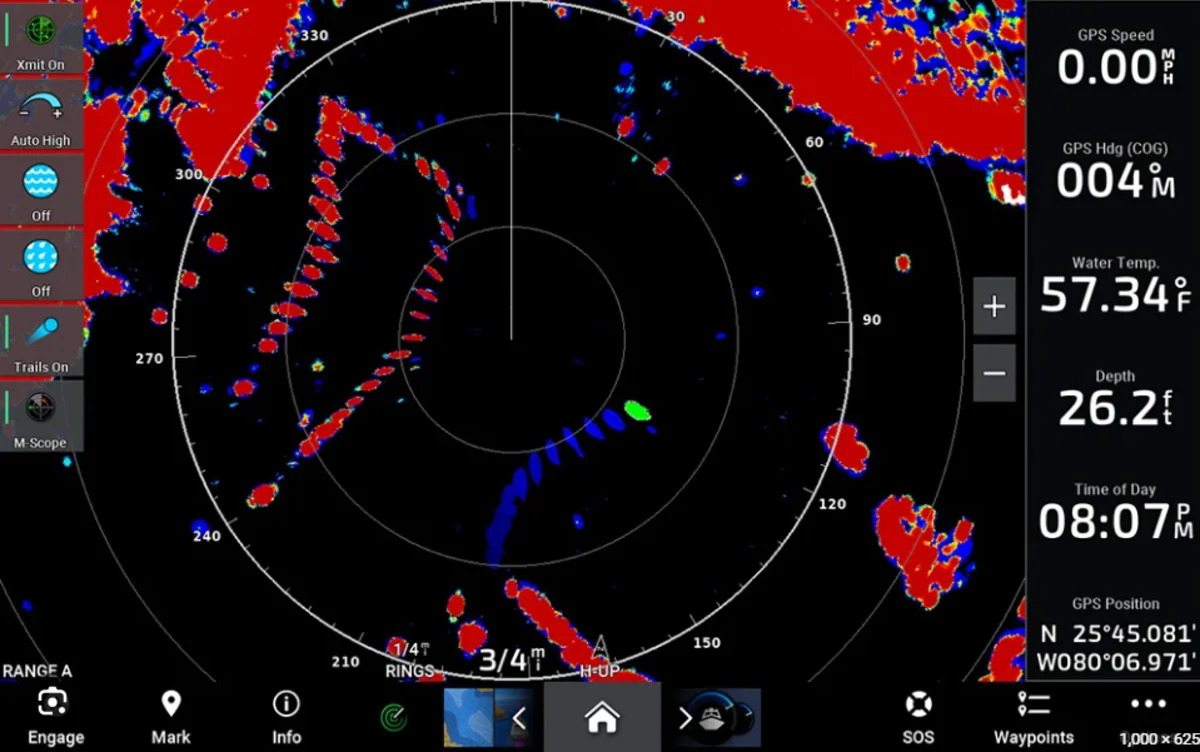
Starlink Mini Offshore: Internet 60 Miles Out Without Yacht Pricing
Full internet at the canyons changed how I plan and fish trips more than any single piece of fishing equipment on my boat — and I say that as the guy with three transducers. But Starlink’s plans are written for RVers and yachts, not center consoles, and picking wrong either cuts you off ten miles from the beach or costs you boat-payment money. Here’s how it actually works on a fishing boat, from someone running it (and working in networking when he’s not).
What internet offshore is actually for
Live sea surface temperature and chlorophyll charts while you’re out there — not yesterday’s shot you downloaded at the dock. Real weather radar when a summer cell builds between you and the inlet. Buoy data on demand. Messages home so nobody worries. And a communications backup that doesn’t depend on VHF range. None of this needs much bandwidth; all of it needs to work 60 miles out. That’s the frame for every decision below.
The hardware: why the Mini
The Starlink Mini is the right dish for a center console: small enough to mount on a T-top, and light on power in a way the bigger dishes aren’t — it runs happily off the boat’s 12-volt system instead of demanding an inverter.
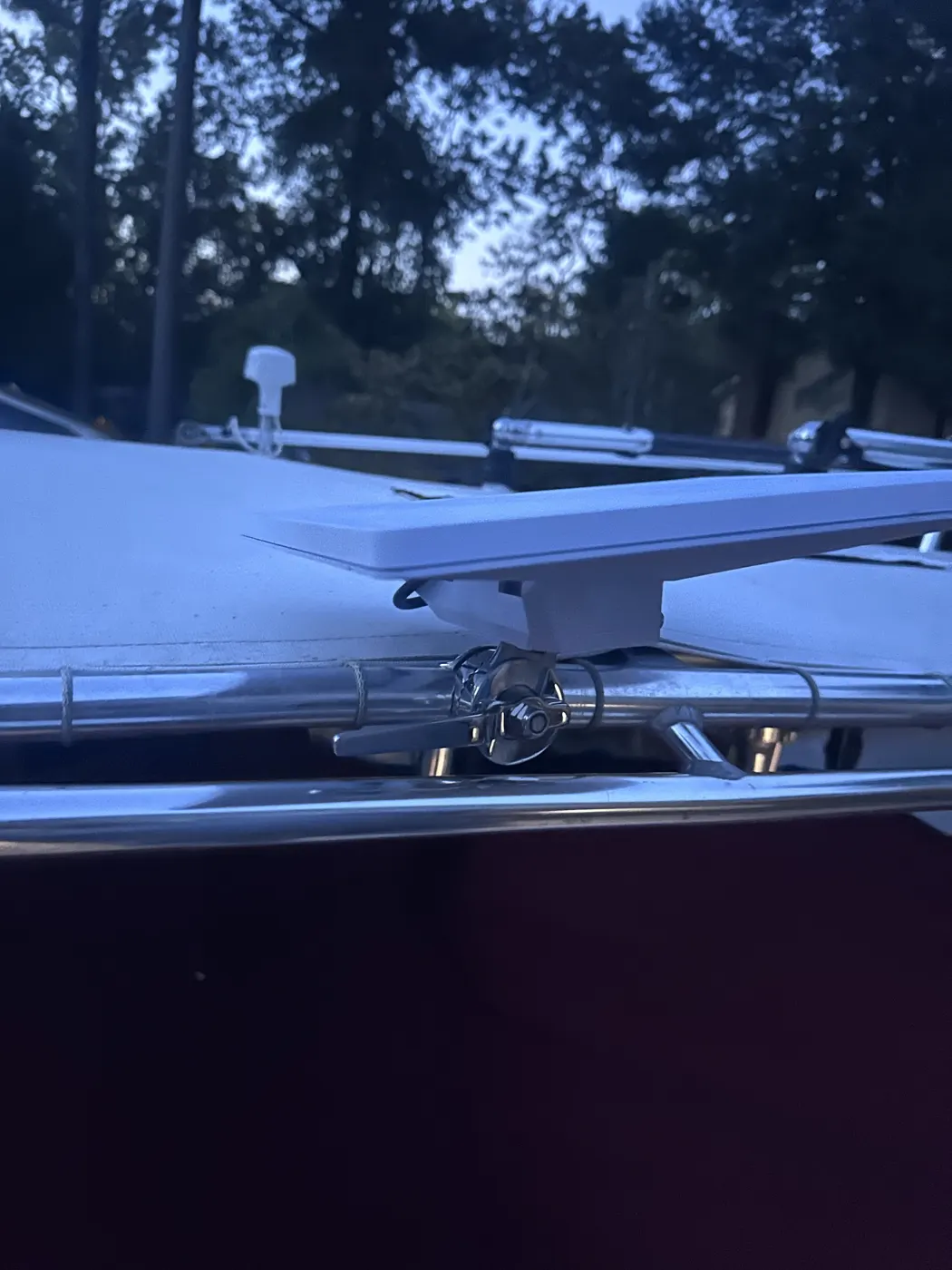
My install is three parts, all straightforward:
- A dedicated Mini mount — purpose-made bracket, solid through boat vibration and trailering.
- A 12V-to-36V step-up adapter to feed the dish from the boat’s DC system. This is the networking-guy move: stepping the voltage up cuts the current the wire has to carry, which means less voltage drop on the run to the mount and a dish that never browns out when the livewell pumps kick on.
- A shorter, heavier-gauge power cable in place of the long stock cord. Same logic — the stock cable is built for RV flexibility, not for the shortest clean run on a T-top. Less cable, thicker wire, cleaner power, nothing coiled up waiting to chafe.
Total install cost is a rounding error next to any other electronics on the boat, and there’s no inverter humming along wasting battery to make AC power the dish converts right back to DC anyway. (The links above are the exact parts on my boat.)
Got a 36V trolling motor battery bank on board? Starlink’s own spec sheet lists the Mini’s DC input rating as 12–48V, drawing up to 60W — which means a 36V bank (the standard setup on most bow-mount trolling motors running three 12V batteries in series) sits comfortably inside that range on its own. No step-up converter needed at all in that case: just run a properly fused DC cable with the correct barrel connector straight off the trolling motor bank to the dish. It’s one less component to fail and one less thing to wire if you’ve already got that 36V bank sitting right there.
Don’t want to wire into the boat’s 12V system at all? That’s the case for a dedicated battery pack instead. The Ennzia E100 clips directly onto the back of the Mini with a connector sized to its power port — no splicing, no step-up converter, nothing permanent. It holds 27,600mAh (99Wh), good for roughly 5 hours at the Mini’s typical 20W draw, and supports pass-through charging, so you can plug it into wall or inverter power without dropping the connection while it tops off. It’s IP65-rated (splash and rain resistant, not a submersion unit — don’t let it sit in bilge water), and at $199.99 it’s a real cost, with a couple of reviewers reporting charging issues after several months of use. But for a dinghy, a kayak, a boat you don’t want to wire into, or just carrying the Mini around the dock, it’s the simplest way to run one without touching the boat’s electrical system.
The plans, decoded for fishermen
This is the part that trips everyone up, so read it before you subscribe to anything:
Roam Unlimited is the plan most boaters start with — and here’s the catch nobody tells you at checkout: it stops working about 10 miles offshore. Roam is a land-coverage plan. Inside that line you have unlimited data; cross it and the dish goes quiet, right about where the fishing starts.
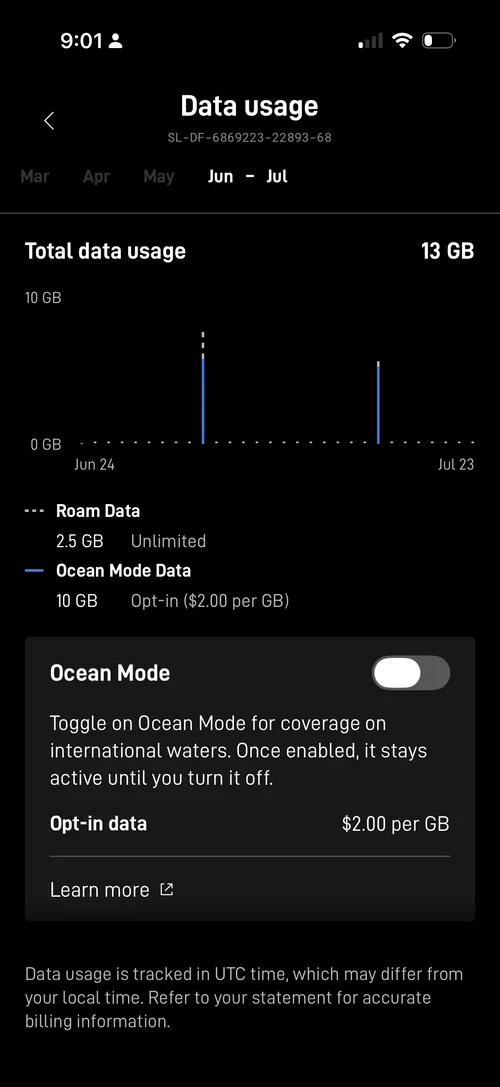
The fix is the ocean data toggle. Flip on offshore (priority) data in the app and the dish keeps working past the line — billed at $2 per GB while you’re out there, though Starlink has announced that rate is rising to $6 per GB effective September 27. You only pay for what you use, only when you’re actually offshore, and it toggles right back off at the dock. Starlink also introduced a new Personal Maritime plan alongside that price change, built for boats that cruise internationally for extended stretches rather than day trips out of the same inlet — see the full breakdown for why it’s very likely not the plan you want.
Global Priority is the other route, and it’s built for a different customer:
| Global Priority plan | Price |
|---|---|
| 50 GB | $250/mo |
| 500 GB | $650/mo |
| 1 TB | $1,150/mo |
| 2 TB | $2,150/mo |
That’s commercial-vessel and yacht pricing. For the average fisherman making a few offshore runs a month, it makes no sense — the cheapest tier costs more per month than most of us spend on ballyhoo in a season.
The math for a fishing boat
Here’s what it actually costs on my boat, and what changes once the new rate lands. Roam Unlimited runs $165/month, and a typical full day offshore burns about 5 GB of SST checks, weather radar, buoy reports, messages, and photos home. At the current $2/GB rate that’s $10 a trip. At the new $6/GB rate starting September 27, the same 5 GB day jumps to $30 a trip. Roam covers the run out and back and every day inside the line; the toggle covers the blue water either way — it’s just a lot more expensive blue water after September 27.
That rate change actually moves the comparison against Global Priority’s 50 GB tier ($250/month flat). At the old $2/GB rate, fishing offshore twice a week only added about $80 a month in ocean data, and the toggle won easily. At the new $6/GB rate, that same twice-a-week habit adds roughly $240 a month — pushing the total past what Global Priority’s cheapest tier costs outright. The rough breakeven is 2 to 3 offshore trips a month: fish less than that and the toggle is still cheaper, fish more than that and Global Priority’s 50 GB tier is worth a second look instead of dismissing it as yacht pricing. See the Personal Maritime plan breakdown for the full math and why the new plan itself still isn’t the answer for a day-tripper.
Discipline is the data plan
The $2/GB rate is only cheap if the boat’s devices behave. The networking-guy checklist before you leave the inlet:
- Download ahead: charts, forecasts, and playlists at the dock on unlimited data — not at sea on metered.
- Kill auto-updates on every phone and tablet aboard. One iOS update at the canyons is a $10 surprise.
- No streaming offshore unless you’ve decided it’s worth it — video is where gigabytes go to die.
- Toggle ocean data off at the dock so it never bills when you don’t need it.
Do that and a full canyon day of weather, SST, and messaging costs less than the ice.
How it performs out there
The number that made the office network guys jealous: 200 Mbps down, running 45 mph offshore, and it never misses a beat. No dropouts on the run, no re-acquiring at the spot, no babying it. That’s faster than most home connections, on a boat, at highway speed, in open ocean. Whatever skepticism I carried aboard about a dinner-plate dish handling a moving, pounding, salt-covered platform — it didn’t survive the first trip.
Practically, that means the SST chart refreshes while you’re running to the numbers, the radar loop is live when weather builds, and a fish photo is home before the fish is in the box.
Bottom line
The Mini plus Roam Unlimited plus the ocean toggle is still the right starting setup for the average offshore fisherman: unlimited data where you idle and rig, metered data only beyond the ten-mile line, and no yacht-tier subscription for most trip frequencies. Know where the coverage line is, keep your devices disciplined, and re-check the math against Global Priority once the toggle rate triples on September 27 — real-time SST at the edge will put you on fish that the dock-download crowd never finds either way.
Selling the boat with the dish still mounted, or moving it to a business account for a charter operation? See how to actually transfer a Starlink Mini to a new account — there’s a real eligibility window and a specific process, not just handing over a login.
This article may contain affiliate links. If you buy through them, we may earn a small commission at no extra cost to you. Learn more.