Marine Bilge Pump Buying Guide: Sizing, Switches, and Wiring That Matters
Nobody thinks about their bilge pump until the boat is taking on water, and by then it’s too late to fix a bad install. This is the least glamorous piece of safety gear on any boat, and it’s also one of the most commonly under-specced — a single pump with the box’s GPH number trusted at face value, wired through whatever gauge wire was already in the boat, with no backup if the float switch jams. Here’s what actually matters.
GPH ratings are a ceiling, not a real number
Every bilge pump is rated in gallons per hour under ideal lab conditions: no vertical lift, no hose restriction, straight discharge. On an actual boat, the pump has to push water up through several feet of hose to a through-hull above the waterline, often through at least one bend, and that head height and hose friction can cut real-world output by a third to half of the rated number. A pump rated 1,100 GPH on the box might move closer to 600-700 GPH once it’s actually plumbed into your bilge. The practical takeaway: size up from whatever number feels like “enough,” and never assume the rating on the box is what you’ll get in an actual emergency.
Sizing by boat length: a starting point, not a ceiling
There’s no single ABYC-mandated GPH figure per boat length, but the general ranges the industry works from are a reasonable starting point for total combined pump capacity:
| Boat length | Combined GPH (rough guideline) |
|---|---|
| Under 20 ft | 700-1,000 GPH |
| 20-25 ft | 1,000-1,400 GPH |
| 26-30 ft | 1,200-1,600 GPH |
| 31-35 ft | 1,400-1,800 GPH |
| 36-40 ft | 1,600-2,200 GPH |
| 41-45 ft | 2,000-4,000 GPH |
Treat these as a floor, not a target — they assume ideal conditions the same way a single pump’s box rating does, so a boat with a long hose run, a lot of vertical lift to the through-hull, or a history of taking on more water than average should size above the range for its length, not to the bottom of it. The bilge pump sizing calculator turns your boat’s length straight into a delivered-GPH target, a box-rating total to actually shop for, and a main/backup/midship split. Hose diameter matters here too: match the hose size to the pump’s actual outlet (commonly 3/4” up to 1-1/2” depending on the pump), since a hose that’s narrower than the outlet chokes flow and throws away capacity you already paid for.
Redundancy beats one big pump
A single large pump is a single point of failure — if its float switch jams on debris or the motor fails, there’s nothing behind it. The layout most experienced boaters land on has three roles, not one:
- Main pump — the lowest-mounted, always-on-duty automatic pump handling routine water: rain, wash-down runoff, minor seepage. This one cycles the most and matters the least in an actual emergency.
- Backup pump — a higher-capacity pump mounted a few inches higher, wired to its own separate switch, that only kicks on if water rises past where the main pump should have handled it. This is your real emergency capacity, and because it’s a separate unit on a separate switch, the main pump failing doesn’t take it down too.
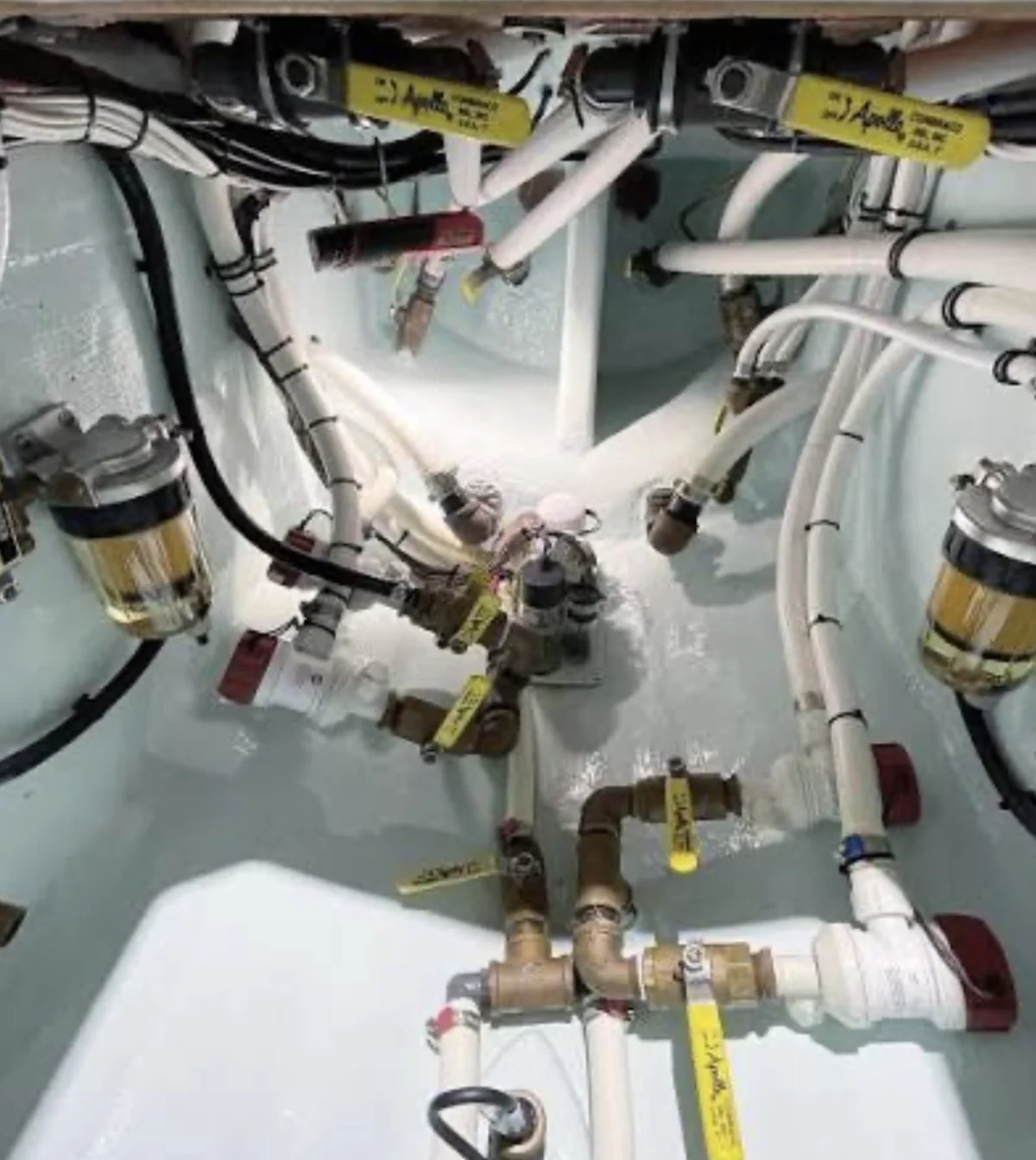
- Midship pump — on larger boats, especially anything with a long or compartmented bilge, a third pump amidships covers a blind spot the bow and stern-mounted pumps can’t reach. Water doesn’t always pool evenly along the keel, and a boat that only pumps from the two ends can still take on water in the middle unnoticed. Whether you need this third pump comes down to boat size and bilge shape more than a fixed rule — a 20-foot center console with a simple, short bilge usually doesn’t need it; a 30-plus-foot boat with a stepped hull or multiple compartments usually does.
High water alarm: the layer above all three pumps
Pumps can only tell you they’re working by working — they don’t tell you if they’re losing the fight. A high water alarm is a separate float switch, mounted above the backup pump’s trigger point, wired to its own audible and visual alarm rather than to a pump. If it ever goes off, it means water is still rising despite everything else already running, which is exactly the information you want before the situation gets worse, not after. It’s cheap, it’s a completely separate system from the pumps themselves, and it’s the difference between finding out about a problem at the dock from a neighbor who heard the alarm and finding out at 2am when the boat’s already taking on serious water.
The Rule Hi-Water Bilge Alarm is a straightforward, well-reviewed version of exactly this: a float switch paired with an 85dB audible and visual alarm gauge. Real owner feedback backs up the exact use case it’s built for — one long-time review describes the alarm catching a leaking valve overnight after the main pump had been accidentally left off, loud enough that a passerby at the marina heard it and called the boat’s owner. That’s the whole point of this layer: it’s meant to be noticed by someone, even if that someone isn’t you.
The gap a local alarm can’t cover: nobody’s around to hear it
An 85dB horn only works if a person is close enough to hear it and knows what it means. A boat sitting on a lift or in a slip on a weekday, with the nearest occupied boat three docks over, can have its alarm sounding for hours before anyone notices — which defeats the purpose for exactly the scenario most boats actually sit in most of the time. The real fix for that gap is a cellular-connected monitoring system rather than a louder horn.
Siren Marine’s Siren 3 is built for exactly this: a $299.99 NMEA 2000-connected device with built-in 4G/5G LTE-M cellular that pushes alerts straight to your phone regardless of who’s standing on the dock. On its own it covers battery voltage and GPS/geofencing (so it also flags the boat moving when it shouldn’t be), and with the add-on wireless bilge and high-water sensors it extends the exact monitoring this article covers — bilge pump run time, cycle counts, and high water detection — out to your phone instead of just to a horn on the boat. It requires an ongoing cellular plan (roughly $22/month, or cheaper on a seasonal or multi-year plan, sold separately through sirenmarine.com) on top of the hardware, which is a real ongoing cost most of the gear in this guide doesn’t have — but for a boat that spends most of its time sitting unattended at a marina, that’s the tradeoff for actually finding out about a problem instead of finding it days later.
Float switch vs. electronic sensing
The traditional mechanical float switch is a hinged arm with a float on the end that rises with the water and trips a switch — simple, cheap, and the single most common bilge pump failure point on real boats, because it’s a moving part sitting in a bilge full of the exact debris (line scraps, dirt, fiberglass dust) that jams a hinge. It’s worth checking that the float actually swings freely every time you’re in the bilge, not just when something seems wrong.
Electronic sensing switches — Rule’s AutoSense system is a common example — have no moving parts at all. They sense water through electrical conductivity between contacts and switch the pump on directly, which sidesteps the jammed-float failure mode entirely. They still need periodic checking (corroded or fouled contacts can cause their own problems), but they remove the specific failure that takes out most float switches. If you’re replacing a pump anyway, an electronic-sensing automatic is generally the safer default over a separate pump-plus-mechanical-float-switch combo.
One more note on switches: older boats sometimes still run mercury float switches. Mercury switches have been phased out across most of the market for environmental reasons, and if you find one on a used boat, it’s a reasonable one to proactively replace rather than wait for it to fail.
Wiring: the detail that decides if it works when you need it
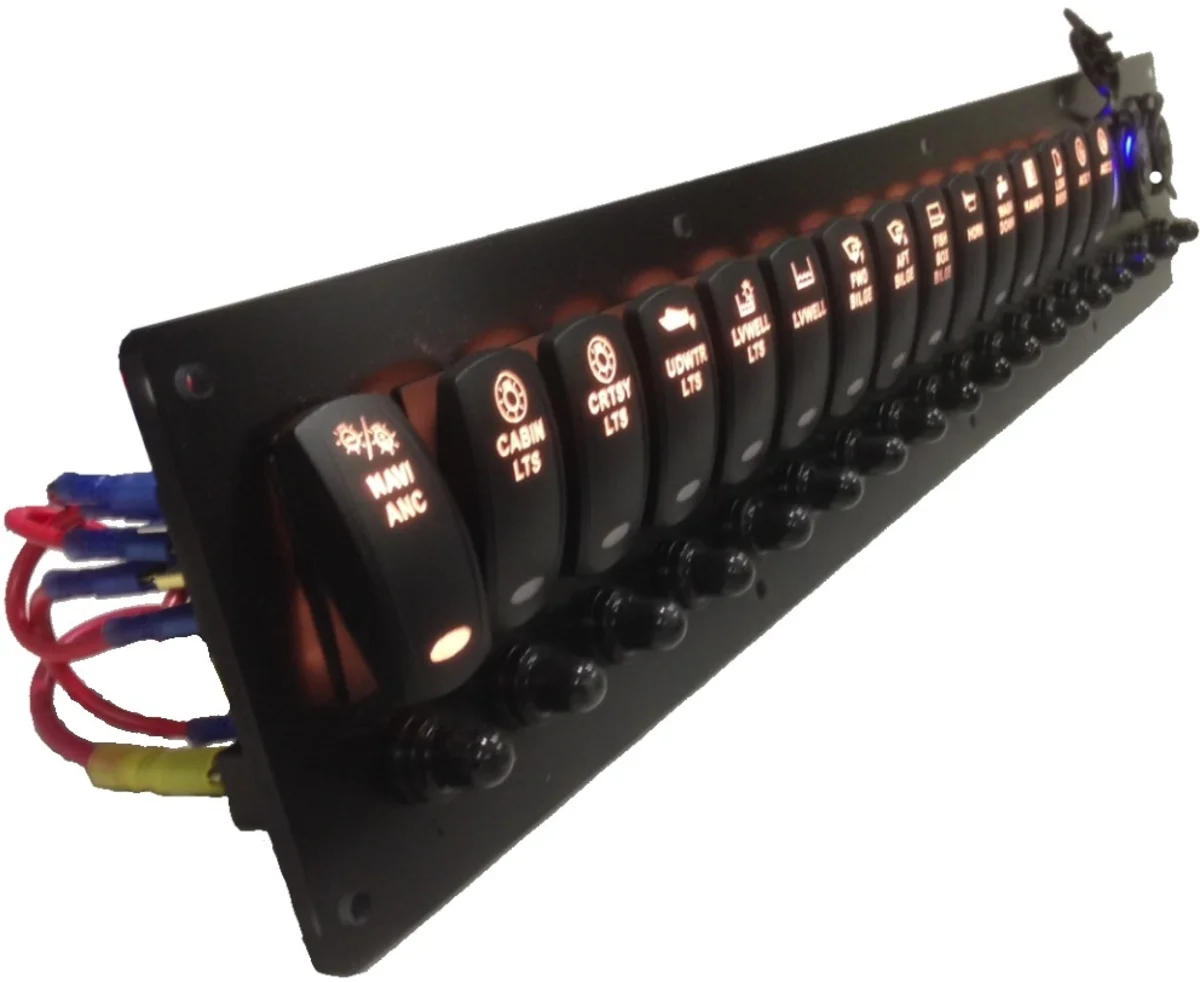
A bilge pump is a critical circuit by ABYC’s own classification — the same category as navigation lights and electronic equipment — which means it should be wired for no more than a 3% voltage drop, not the more relaxed 10% allowed for non-critical accessories. Undersized wire on a bilge pump run means the pump sees reduced voltage and pumps less water at exactly the moment you need full rated output, which defeats the purpose of buying a bigger pump in the first place. Size the wire to the pump’s actual amp draw and the real length of the run (out to the pump and back), and don’t reuse whatever thin wire happened to already be routed to that corner of the bilge — the switch panel build/repair guide covers this same sizing math in more depth, along with matching breakers to the wire and why adhesive-lined heat shrink matters on every connection that can see moisture.
The other detail worth knowing: standard marine wiring practice runs the automatic bilge pump circuit directly off the battery, ahead of the boat’s main battery switch, rather than through it. The reasoning is straightforward — if someone leaves the battery switch off while the boat is docked or being worked on, an automatic pump wired through that switch can’t do its job if water starts coming in. Wiring it ahead of the switch means the automatic pump keeps working regardless of switch position; the tradeoff is a small parasitic draw on the battery at all times and a bit more care needed around corrosion protection at that connection, since it’s live continuously. Most boaters consider that tradeoff worth it — a dead battery is a recoverable problem; an automatic pump that silently stopped working because the switch was off is not.
What to actually buy
Primary automatic pump: the Rule RM1100B is a 1,100 GPH automatic with AutoSense electronic switching — no mechanical float arm to jam, plus thermal cutoff and backflow prevention built in. A solid, widely-used choice for routine automatic duty on a boat this size class.
High-capacity backup: the Rule 02 High-Performance is rated 1,500 GPH and is sold as a non-automatic pump, meaning it needs to be paired with its own separate float switch — which is exactly the point. Mounting this one higher in the bilge on its own switch gives you genuine backup capacity that doesn’t share a single point of failure with the primary pump.
The switch I actually pair it with: the ULTRA Bilge Pumpswitch Jr. (UPS-02) is the one I run based on my own experience with it. It’s a positive-action mechanical switch with no electronics or time delays to fail, ignition-protected, and built from corrosion-resistant stainless steel — not cheap at around $239, but owner reports of 15-25+ years of trouble-free service on the exact same switch are common, which is a different league from the float switches that ship stock with most pumps. It’s the switch I’d put on the backup pump specifically, since the backup is the one you most need to actually work the one time it matters. Worth wiring in a manual override toggle alongside any auto float switch too, so a stuck float doesn’t leave you without a way to run the pump by hand.
The alarm: the Rule Hi-Water Bilge Alarm covers the layer above both pumps — see above for why that separate layer matters.
Maintenance: the five-minute check that actually matters
Test every pump manually at the panel switch, not just by waiting for the float to trip — a pump that doesn’t come on when commanded directly has a wiring or motor problem regardless of what the float does. Check that the strainer base is clear of debris, since a clogged intake will burn out a motor running dry or against a blockage. Physically move each float switch (or, for electronic sensing pumps, check the contacts) to confirm nothing is stuck, and test the high water alarm the same way — lift its float by hand and confirm it actually sounds. And look at the wiring connections for the telltale green corrosion that shows up on bilge wiring long before a wire actually fails — catching it early is a lot cheaper than finding out at the worst possible moment.
Bottom line
Buy more capacity than the box number suggests you need, run separate pumps on separate switches instead of one bigger pump, add a high water alarm above them as the layer that actually tells you if they’re losing, and don’t let undersized wire quietly rob any of it of the output you paid for. None of this is complicated or expensive — it’s just the kind of maintenance-adjacent gear that gets skipped until the one time it actually matters.
This article may contain affiliate links. If you buy through them, we may earn a small commission at no extra cost to you. Learn more.