The High-Speed Planer Kit Most High-Speed Trollers Never Rig
Most boats running the high-speed wahoo program never put a planer in the water. It’s not that planers don’t work at speed — it’s that a standard planer can’t survive it, so the whole category gets written off as a 6-8 knot tool and left out of a 12-16 knot spread entirely. That’s leaving fish in the water. A purpose-built high-speed planer changes the math, and it’s worth adding to the program instead of skipping.
Why the planer gets left out of a fast spread
A standard trolling planer “blows out” well before high-speed trolling speeds — it stops diving, starts skipping across the surface, and quits doing its job right around the same speed a lot of boats are just getting started at. That’s the whole reason the planer setup already on this site is built around 6-8 knots: it’s the speed range a standard planer actually holds down. Ask that same planer to ride behind a 14-knot spread and it’s not fishing anymore, it’s just dragging.
A high-speed planer is a different tool built for exactly this gap — designed to keep diving at speeds standard planers can’t touch, so it can ride alongside the rest of a fast surface spread instead of forcing the whole boat to slow down for one line.
What that one deep bait actually does
The case for running a bait 15 to 50 feet down while everything else stays on top isn’t complicated: fish don’t always sit where a surface spread can reach them. Late in the day, or once the surface heats up, gamefish and the bait they’re keying on often hold deeper in the water column, avoiding the warmest water right at the top. A surface-only spread can go quiet in exactly that situation while a planer bait riding down in cooler water keeps producing — and it doesn’t cost you the rest of the spread to run it. Wahoo strikes in particular tend to go up on a bait that’s actually down in the strike zone rather than skipping across the top.
How much line actually gets you down there
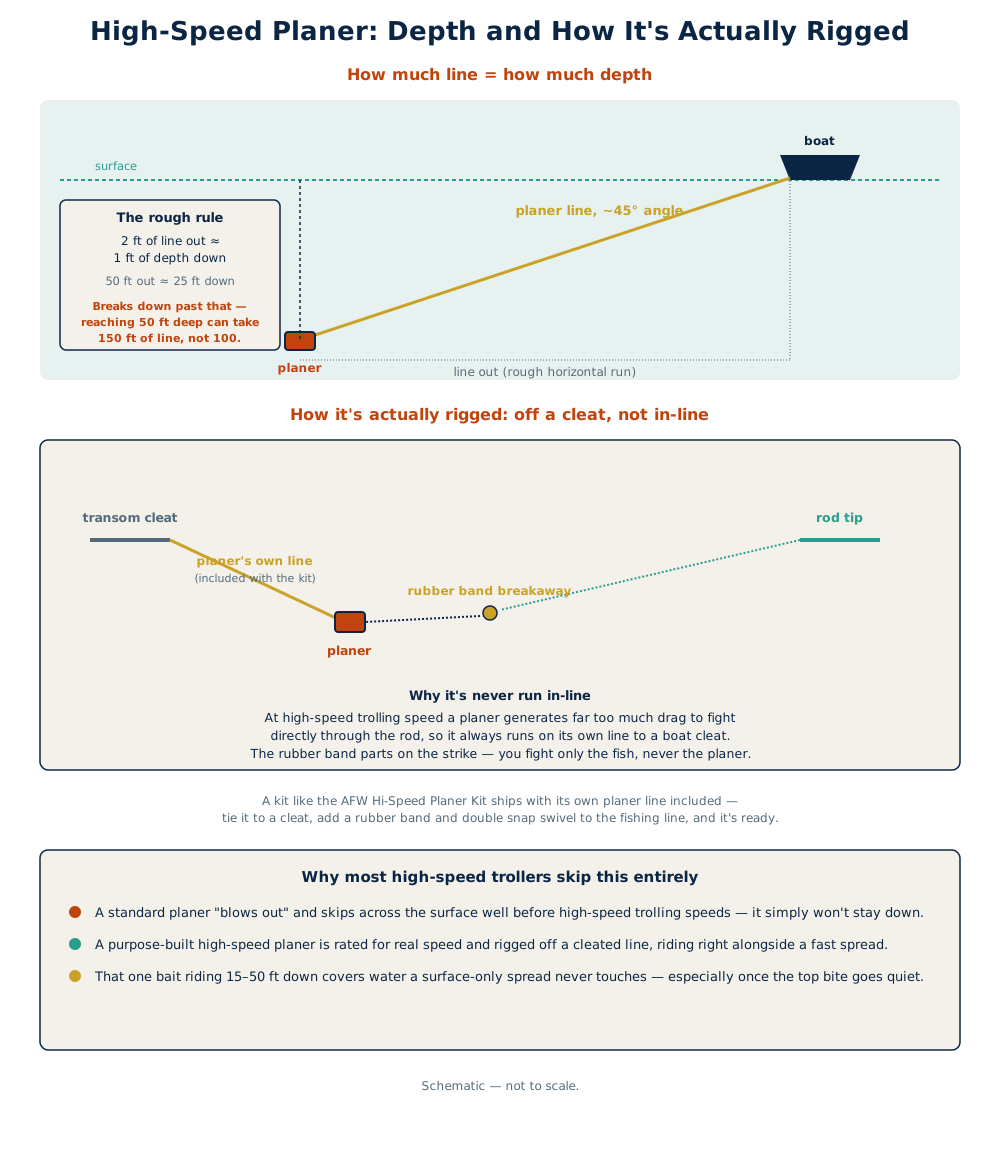
Planer depth isn’t dialed in precisely the way a downrigger’s is — you’re estimating based on how much line is out and the angle the planer rides at, which sits at roughly 45 degrees under tow. The rough rule: 2 feet of line out gets you about 1 foot of depth down, so 50 feet of line out rides around 25 feet deep. That ratio holds reasonably well for moderate depths, but it breaks down the deeper you push it — getting a planer down to 50 feet can take something closer to 150 feet of line out, not the 100 feet the simple ratio would suggest. Plan on checking your actual depth against conditions rather than trusting the math past the easy range.
How it’s actually rigged
A high-speed planer generates too much drag at trolling speed to ever fish directly in the leader — there’s no viable “in-line” version of this rig, full stop. It always runs on its own line, tied off to a transom cleat, completely separate from the fishing line. The fishing line connects to the planer’s line with a rubber band and a double snap swivel; when a fish strikes, the band parts and the angler fights only the fish on a clean line, with the planer left out there on its own cleated line to be dealt with separately once the fish is at the boat.
The AFW Hi-Speed Planer Kit — a size #8 with a stainless steel blade — ships exactly this way: 36 feet of 300 lb-test mono included as the planer’s own line, meant to be tied to a cleat rather than snapped into your leader. Add a rubber band and a double snap swivel to connect it to the fishing line, and it’s ready to run.
Rigging the bait itself
Forget the ballyhoo here — a planer running behind a genuine high-speed spread pulls the same kind of jetted, skirted trolling lure filling out the rest of that high-speed program, not a wire-and-ballyhoo combo built for 6-8 knot planer work. A stainless-head lure like the VIKETECH 10/0 trolling lure comes pre-rigged on 700 lb cable with tandem 10/0 hooks already crimped in — no haywire twist or bait prep required, just clip the leader to the planer’s line and go. Stick to the same dark palette — purple/black, black, and other low-light colors — that already works for the rest of the high-speed spread, and lean on cable over single-strand wire for this one specifically: a lure taking planer drag all day benefits from cable’s abrasion resistance more than a bait rig running off a corner line does.
Bottom line
Most high-speed spreads leave the planer in the garage because the planer they’re picturing genuinely can’t handle the speed. A high-speed-rated planer doesn’t have that problem — tied off to a cleat on its own line, with a rubber band breakaway to the fishing line, it gets a bait into water the rest of the spread never touches, without slowing the boat down or making you fight the planer along with the fish.
This article may contain affiliate links. If you buy through them, we may earn a small commission at no extra cost to you. Learn more.