Garmin GPSMAP Series Compared: x3, 10x2/12x2, 8000, and 9000
GPSMAP is Garmin’s top tier for a reason — it’s the family with the deepest NMEA 2000 and marine Ethernet networking, the best sonar processing, and the only line that scales from a 7-inch bay boat unit up to a 27-inch glass-bridge display on a sportfish helm. Here’s how the current lineup actually breaks down. For the bigger-picture comparison against ECHOMAP and STRIKER, start with the lineup overview.
GPSMAP x3 series (7x3, 9x3, 12x3) — the current mid-to-upper range
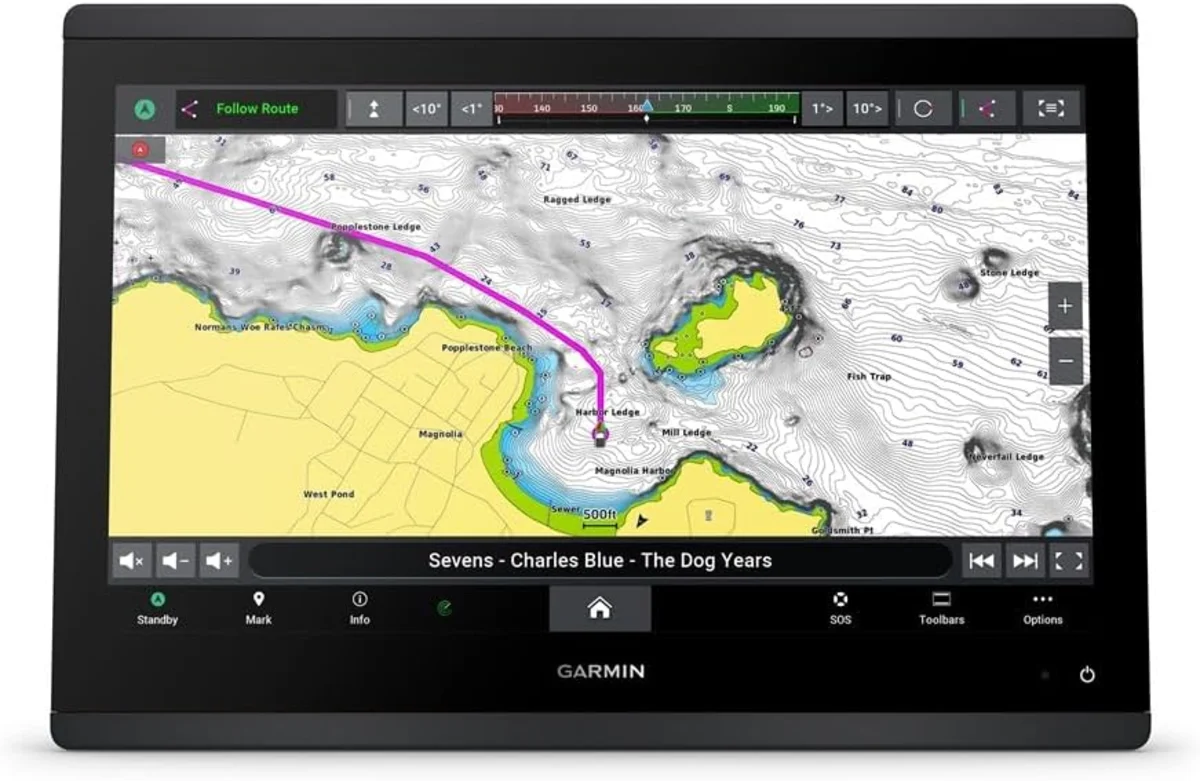
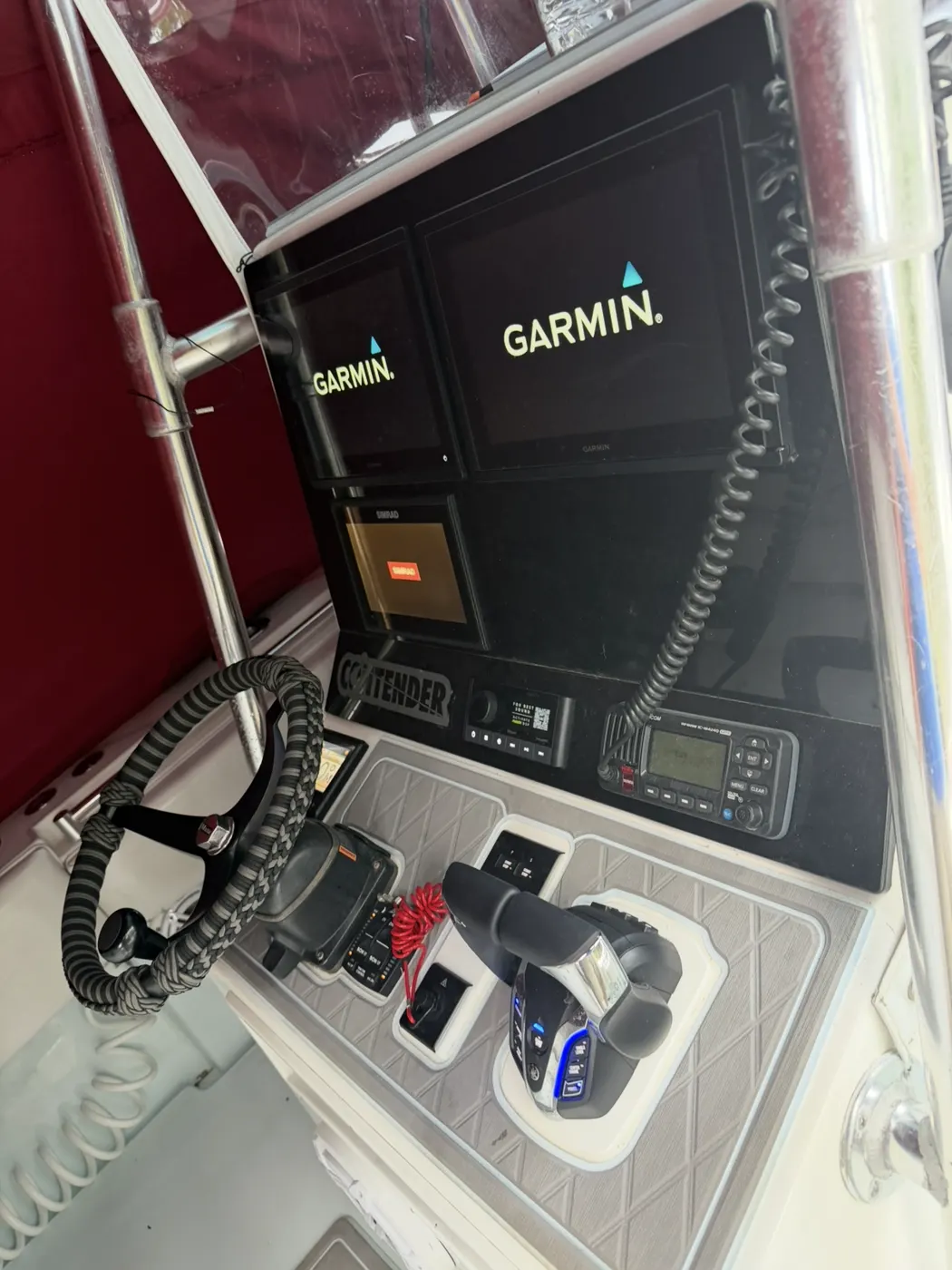
This is the direct successor to the older xsv naming (a 1243xsv is, functionally, what a 12x3 is today — the 1643xsv pictured above is the larger 16” version of that same generation). Touchscreen displays in 7”, 9”, and 12” sizes, running roughly $1,200 for the 7” up to $3,000+ for the 12” combo unit with sonar. These are built as full chartplotter/sonar combos — optional built-in CHIRP, ClearVü, and SideVü sonar depending on the exact model — with the NMEA 2000 networking to run alongside radar, autopilot, and trolling motor integration. This is the tier most serious offshore center consoles and bay boats actually run, and it’s what I have twin units of at my own helm.
GPSMAP 10x2/12x2 — the keyed-control alternative
Same core capability as the x3 series, but with physical keyed controls instead of a touchscreen-first interface. Worth knowing if you fish in a following sea or with wet, gloved hands: a touchscreen that won’t register a swipe when it’s covered in spray is a real problem offshore, and buttons don’t have that failure mode. If you want GPSMAP-level networking and sonar but distrust touch-only control at speed, this is the line to look at instead of the x3.
GPSMAP 8000 series — the previous-generation flagship
Garmin’s prior large-format glass-bridge line, still sold and supported, built around bigger touchscreen displays for sportfish and yacht helms. The 8000 series also has black box options (like the GPSMAP 8700 Black Box) that let you run Garmin’s processing and sonar behind a third-party or custom touchscreen monitor — useful for a custom helm build where you don’t want a Garmin-branded bezel dictating the layout.
GPSMAP 9000 series — the current flagship
The replacement for the 8000-series glass-bridge units, and Garmin’s most capable chartplotter line, period. Screens run from 10 inches (full HD) up through 13 to 27 inches at 4K resolution, with pricing that starts around $10,000 for the big glass-helm units and runs into the mid-teens for the largest displays. There’s also a 9000xsv combo-unit variant (touchscreen plus built-in sonar) in smaller sizes running roughly $3,200-$7,200 — a genuine step up in processing speed and resolution over the 8000 series, aimed at boats where the helm display is as much a statement as a tool. Like the 8000 series, a GPSMAP 9500 Black Box option exists for custom installations.
What actually sets the tiers apart: networking, transducers, and inputs
Every GPSMAP tier shares the same networking ceiling — that’s the whole point of the family. The differences between x3, 10x2/12x2, 8000, and 9000 are size, control method, and processing headroom, not what the unit can talk to.
| x3 (7x3-12x3) | 10x2/12x2 | 8000 series | 9000 series | |
|---|---|---|---|---|
| Networking | NMEA 2000 + NMEA 0183 + full Garmin Marine Network | Same as x3 | Same as x3 | NMEA 2000 + NMEA 0183 + Garmin BlueNet (Gigabit Ethernet) |
| Radar / LiveScope / video-in | Fully supported | Fully supported | Fully supported | Fully supported, plus best suited to LiveScope 2’s higher data rate |
| Marine Ethernet ports | Garmin Marine Network, standard connector count for the size class | Same as x3 | Garmin Marine Network, standard | Garmin BlueNet — Gigabit Ethernet, backward-compatible with legacy Marine Network via a BlueNet 30 gateway |
| Processing / network speed | Current-generation processor | Current-generation processor | Previous-generation processor and network interfaces | Network interfaces roughly 10x faster than 8000, faster chart-rendering processor |
| Display | Up to 12” touchscreen | Keyed control, same panel quality as x3 | Up to 1,000-nit brightness, HD resolution | Up to 1,200-nit brightness, 4K (3840×2160) on larger sizes |
The practical read: all four GPSMAP tiers run the identical NMEA 2000 and NMEA 0183 layers, and the same marine Ethernet backbone that runs radar, sonar modules, and cameras off the same port — the 9000 series just runs that Ethernet layer as Garmin BlueNet rather than the legacy Marine Network the other three tiers use. Nothing in this family is locked out of any accessory the way STRIKER and ECHOMAP are. What changes between tiers is horsepower and glass: 9000 over 8000 buys a materially faster network (BlueNet’s Gigabit Ethernet versus the legacy network’s lower throughput) and processor, a brighter and sharper (up to 4K) display, and the extra bandwidth that matters most if you’re running the latest Panoptix LiveScope 2 alongside radar and multiple cameras on one boat. For a typical center console running a chartplotter, one sonar module, and maybe radar, the x3 or 10x2/12x2 lines have the same networking depth as the flagships — the 8000/9000 jump is about a bigger, faster helm display, not more capability underneath. GPSMAP is also the only family with full Panoptix LiveScope support across the board — the transducer buying guide covers matching a transducer to that capability, and the marine Ethernet/BlueNet guide covers the networking side in depth.
Which one actually fits your boat
A single-engine center console or bay boat doing real offshore miles: the x3 series (7x3-12x3) is the sweet spot, sized to the boat and priced to match. Fishing in real chop and don’t trust a touchscreen in spray: look at the 10x2/12x2 keyed line instead. Building a custom helm with a third-party display: the 8000 or 9000 series black box options let Garmin’s brain drive someone else’s screen. Running a sportfish boat or anything where the helm is a 20+ inch glass bridge: that’s 9000-series territory, and the budget to match.
Why GPSMAP over ECHOMAP if you’re already spending real money
The jump from ECHOMAP Ultra 2 to GPSMAP x3 isn’t really about screen quality — it’s about what else talks to the unit. GPSMAP’s NMEA 2000 depth is what lets a Force Kraken trolling motor spot-lock from the chartplotter, and what lets an MSC 10 satellite compass feed a full autopilot system cleanly. If you’re not building out that ecosystem, ECHOMAP’s Ultra 2 gets you most of the sonar and mapping quality for real savings. If you are, GPSMAP is the only family with the networking to support it.
This article may contain affiliate links. If you buy through them, we may earn a small commission at no extra cost to you. Learn more.