Garmin STRIKER Compared: Cast, Plus, and Vivid
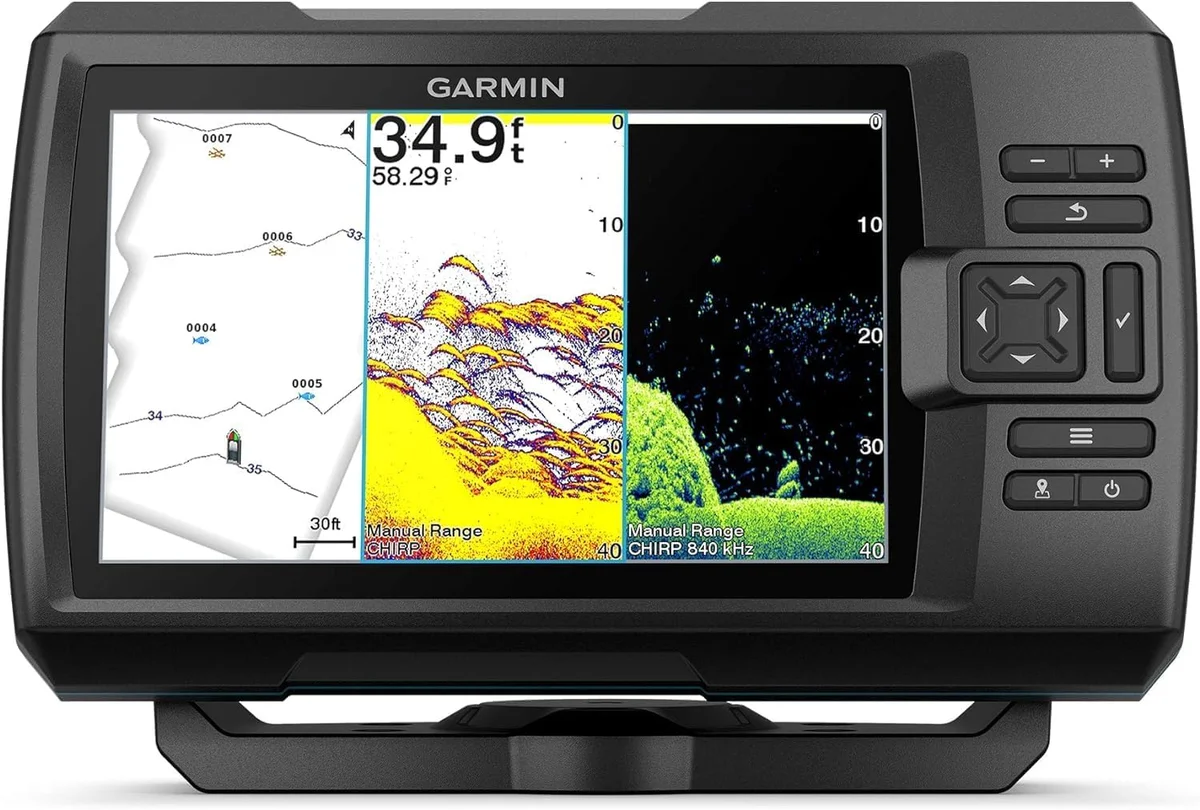
STRIKER is Garmin’s entry tier — keyed controls, GPS plus CHIRP sonar, and prices that start under $150. It’s not the family to build an offshore helm around, but it’s the right call for a kayak, a jon boat, a small skiff, or a cheap backup unit. For where STRIKER sits against Garmin’s other two families, start with the lineup overview.
STRIKER Cast — sonar with no screen at all
A castable sonar-and-GPS puck that pairs to your phone instead of a dedicated display. Throw it out on its own line or clip it to a rod, and it streams sonar and GPS to the Garmin app. It’s the cheapest way into real sonar, and it’s genuinely useful for bank fishing or scouting a spot before committing a boat to it — but it’s a phone-dependent tool, not a helm unit.
Base STRIKER — the true entry chartplotter
3.5 to 4-inch color displays with keyed control, built-in GPS, and CHIRP sonar. No Quickdraw Contours mapping, no color-enhanced sonar palette — just the fundamentals at the lowest price in the lineup. This is the “does the job and nothing more” tier: fine for a small jon boat or as a dead-simple backup, but the next tier up adds real capability for not much more money.
STRIKER Plus — adds real mapping
Same core sonar as base STRIKER, plus Garmin’s Quickdraw Contours software, which lets you build your own high-detail depth maps of water Garmin doesn’t already chart well — genuinely useful on small lakes, backwaters, and skinny-water areas where off-the-shelf charts are thin. Sizes run from a 4-inch display up through larger screens in the 5-9 inch range, with prices starting around $180.
STRIKER Vivid — the sharpest entry-level sonar
The current top of the STRIKER line, adding a brighter, higher-contrast color palette that makes fish arches and structure easier to read at a glance — the actual difference between Plus and Vivid is display processing, not hardware capability underneath. Sizes run 4cv ($200), 5cv ($350), 7cv ($420), up through a 9-inch model around $650. ClearVü scanning sonar is included on the cv models, which is a real step up in target detail over traditional CHIRP alone.
What actually sets the tiers apart: networking, transducers, and inputs
STRIKER’s four tiers look similar on a spec sheet, but the differences that matter are underneath the screen.
| Cast | Base STRIKER | STRIKER Plus | STRIKER Vivid | |
|---|---|---|---|---|
| Networking | None — pairs to a phone, doesn’t join a boat network at all | NMEA 0183 only — basic GPS/waypoint sharing | NMEA 0183 only | NMEA 0183 only |
| Wi-Fi / app pairing | Bluetooth to phone (its whole reason for existing) | No | Yes, for ActiveCaptain | Yes, for ActiveCaptain |
| Transducer | Built-in castable sonar ball, sealed, not swappable | Fixed transducer, CHIRP sonar only, no ClearVü | GT20-TM bundled, ClearVü scanning sonar on cv models | Same GT20-TM/ClearVü as Plus — no transducer difference from Plus |
| Radar / LiveScope / video-in | Not supported | Not supported | Not supported | Not supported |
The practical read: none of STRIKER’s four tiers do NMEA 2000, so nothing in this line will ever talk to a Garmin Marine Network device — no radar, no Panoptix LiveScope, no camera feed, on any STRIKER at any price. What you’re actually paying to move up the tiers is mapping software (Plus adds Quickdraw Contours) and display processing (Vivid’s color palette), not networking capability or even a different transducer between Plus and Vivid. If any of those NMEA 2000 features matter to your boat, that’s the signal to look at ECHOMAP or GPSMAP instead — STRIKER simply doesn’t have the hardware for it at any tier. For more on the GT20-TM transducer itself and how it compares across the Garmin lineup, see the transducer buying guide.
Which one fits your boat
Bank fishing or want to scout water before launching a boat: STRIKER Cast. A small jon boat, kayak, or a dead-simple backup unit where price is the only concern: base STRIKER. Fishing small lakes or skinny water where you want to build your own depth maps: STRIKER Plus. Want the sharpest possible display and scanning sonar detail at entry-level prices: STRIKER Vivid, sized to what your boat can mount.
When to skip STRIKER entirely
STRIKER tops out around 9 inches and doesn’t do the NMEA 2000 networking that lets a chartplotter run alongside radar, autopilot, or trolling-motor integration — once a boat needs any of that, it’s time to look at ECHOMAP or GPSMAP instead. STRIKER’s job is being the cheapest real sonar you can put on a small boat, and it does that job well — it’s just not built to grow into anything bigger. The boat networking overview covers what that NMEA 2000 layer actually adds once a boat outgrows STRIKER’s NMEA 0183-only wiring.
This article may contain affiliate links. If you buy through them, we may earn a small commission at no extra cost to you. Learn more.