Tautog Wreck Fishing: The Mid-Atlantic Blackfish Guide
Tautog get overlooked on a lot of mid-Atlantic and Carolinas boats because they don’t fit the offshore-trolling or deep-drop mold — they’re a cold-water, structure-hugging fish that wants you parked directly over a wreck with a crab on the hook, not a spread out the back. But pound for pound they’re one of the hardest-fighting bottom fish around, and once you learn to read the bite, a good wreck can produce a fast limit of “knothead-sized” blackfish that most boats run right past.
What tautog are, and where to find them
Tautog — “blackfish” in a lot of mid-Atlantic dock talk, and a completely different fish from the “blackfish” nickname you’ll hear for black sea bass on Carolinas docks (see the naming traps in our East Coast fish names guide) — are a structure-obsessed species. They live tight to wrecks, rock piles, reef balls, rubble, jetties, and bridge pilings, and they don’t wander far from cover. That makes them one of the more location-dependent fish you’ll target: find the right piece of hard bottom and you can load the boat; miss it by 30 feet and you’ll get nothing.
Tautog are primarily a Virginia-through-New-Jersey fish, with the bite extending into Maryland and Delaware wrecks and, in the coldest stretches of the season, pushing down into North Carolina’s northern wrecks and nearshore structure. South of that, they thin out fast — this is a mid-Atlantic program more than a Carolinas one, which is part of why it doesn’t get the attention here that grouper and snapper fishing does.
When to target them
Tautog are a cold-water fish. The bite in the mid-Atlantic runs in two windows: a fall push from roughly October through December as water temperatures drop, and a spring window from March into April before it warms back up. Peak summer heat shuts the bite down almost entirely — the fish either move to deeper, cooler structure or simply stop feeding aggressively inshore. Plan trips around falling or still-cool water temperatures, not calendar dates alone.
Tackle: built to horse fish out of structure, not finesse them
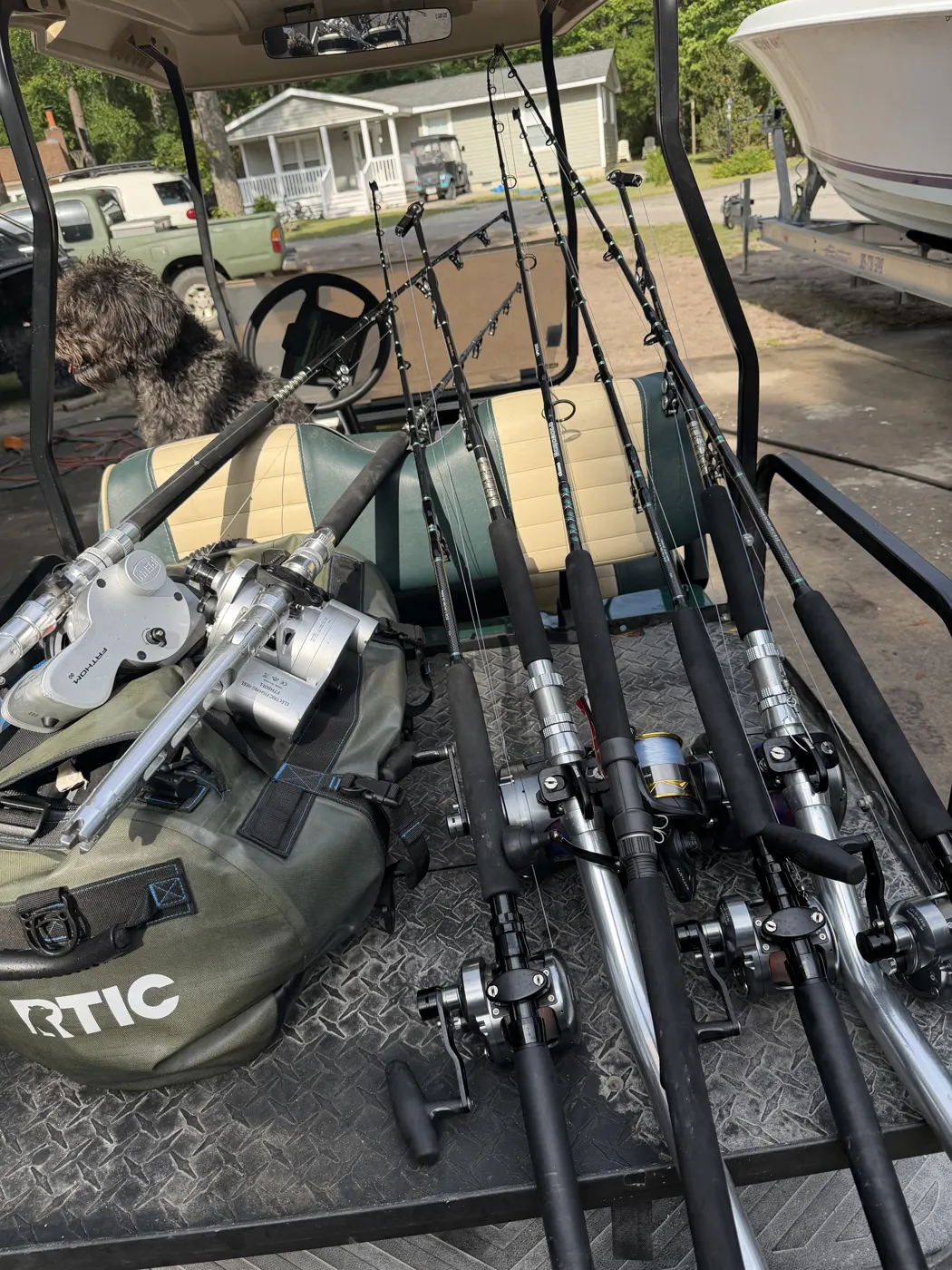
Tautog fishing is not a finesse game. The second a tog feels the hook it drives straight back into the wreck, and if you don’t turn its head immediately you’re breaking off in the structure. Tackle reflects that:
| Component | Typical spec | Why |
|---|---|---|
| Rod | Short (6–7 ft), stout, fast-action conventional or heavy spinning | Leverage to turn a fish’s head before it reaches cover |
| Reel | Conventional or heavy spinning, strong drag | Stopping power on the initial run |
| Main line | 30–50 lb braid | No stretch — you need to feel a soft peck-peck bite through a taut line |
| Leader | 40–60 lb fluorocarbon | Abrasion resistance against barnacle-crusted wreckage |
| Hooks | Short-shank, wide-gap “blackfish” or Virginia-style hooks, sizes 1/0–3/0 | Matches a crab bait’s profile and holds in a tog’s tough mouth |
This is heavier gear than most anglers expect for a fish that rarely tops 10 pounds — but the fight happens in the first three feet, right in the structure, and that’s where the fish is won or lost.
Rigs: knocker rig or a tog jig
Two approaches cover almost all tautog fishing:
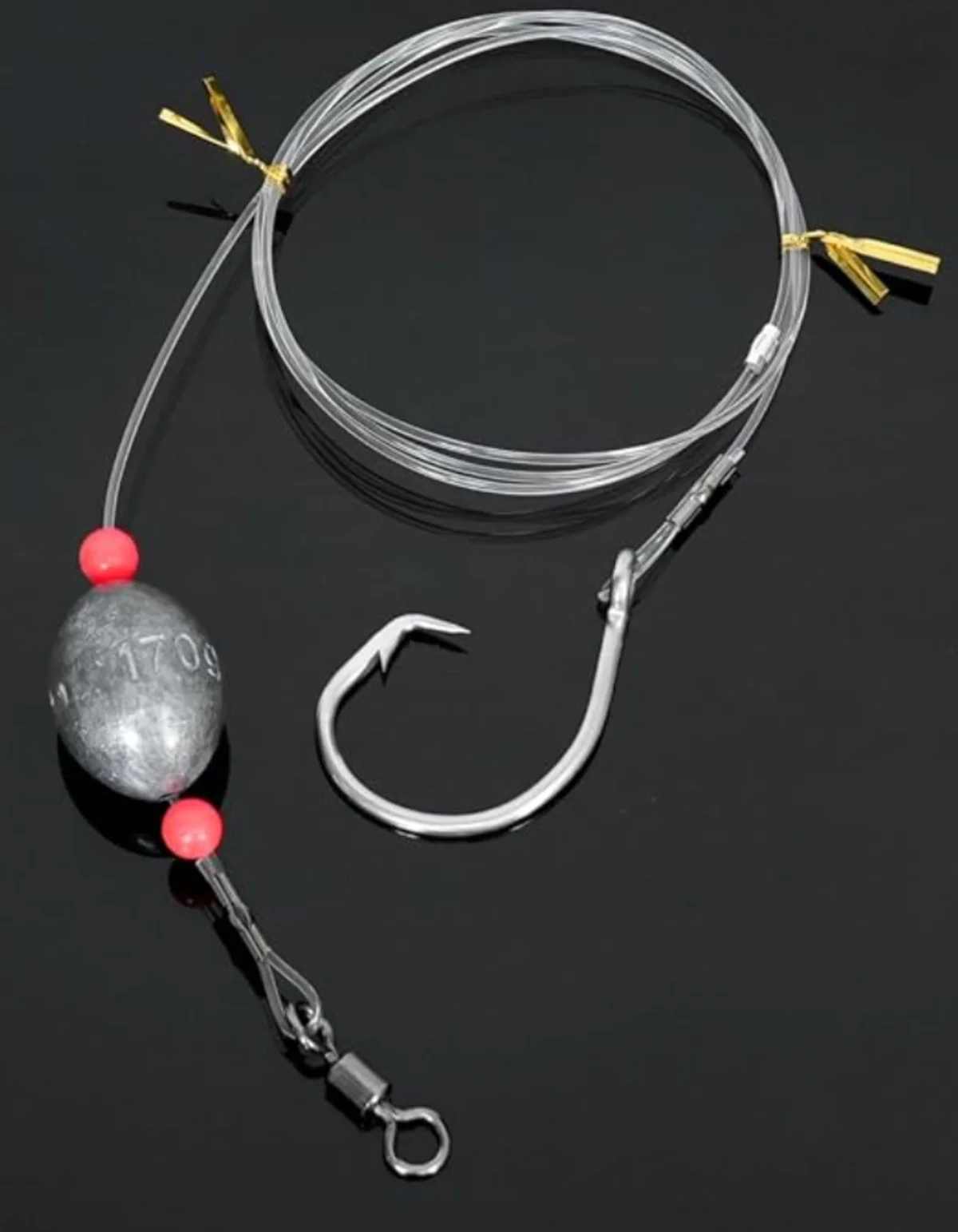
The knocker rig — the same simple rig used for grouper and snapper (see our chicken rig vs. knocker rig breakdown) — is the traditional choice. An egg sinker rides right down against the hook with a bead to protect the knot, keeping the whole rig compact so it doesn’t hang up in the wreckage on the drop.
A tog jig — a jig head, usually ½ to 2 oz depending on depth and current, tipped with a crab instead of soft plastic — has become the more popular option in a lot of mid-Atlantic tog circles. The jig eliminates the separate sinker entirely, sits the bait right on bottom, and telegraphs the bite more directly through the line since there’s no swivel or dropper loop absorbing it. Weight scales with depth and drift speed the same way sinker weight does on a knocker rig.
Either way, keep the whole rig short and simple. Tautog fishing is a vertical, over-the-structure game, not a multi-hook spread — leave the chicken rig and its dropper loops for scattered bottom and other species.
Bait: green crabs first, everything else second
Green crabs, halved or quartered depending on size, are the standard tautog bait and out-produce everything else most days. White leg (calico) crabs and Asian shore crabs are strong secondary choices where they’re available, and fresh clam will work in a pinch but isn’t the first choice when crabs are on hand.
Hook the crab through a leg socket so the point rides through the body — a properly hooked crab stays lively and holds up to repeated short-strike bites instead of getting picked off the hook whole.
Reading the bite and setting the hook
Tautog bites are notoriously subtle before they aren’t. The classic pattern is a series of light pecks and taps as the fish works the bait, then a distinct, harder pull-down as it actually eats. Set on that pull-down, not on the pecks — swinging early just pulls the bait away from a fish that hasn’t fully committed. Once you connect, the fight is short and violent: turn the fish’s head immediately and pull it up and away from the structure before it gets its bearings, because a tog given even a second to think will bury itself in the wreck and cut you off.
Staying on the spot
Because tautog hold so tight to individual pieces of structure, precise boat positioning matters more here than on almost any other bottom fishing trip. A hard anchor set directly over the wreck is the traditional approach, but it’s slow to reposition if you’re off by even a boat length. A trolling motor with GPS spot-lock solves that problem — park on the exact waypoint, and if the bite dies you can slide the boat a few feet without pulling and resetting an anchor. See our Garmin Force Kraken review for how that workflow plays out on a center console working small structure.
Good bottom detail on the sounder matters just as much as positioning — you’re often distinguishing one productive piece of wreckage from open sand a few feet away. Our guides to choosing offshore electronics and CMOR mapping chips vs. stock charts cover the tools that make finding — and staying on — that structure easier.
Regulations
Tautog regulations vary significantly by state, with different size limits, bag limits, and seasons in Virginia, Maryland, Delaware, New Jersey, and New York, and they get revised periodically as stock assessments come in. Check your specific state’s current regulations before every trip — this guide doesn’t track season-by-season limits.
Bottom line
Tautog fishing rewards precision over volume: the right piece of structure, a simple compact rig, a live green crab, and tackle stout enough to win the fight in the first three feet. It’s a different rhythm than trolling a spread or working a chicken rig over scattered bottom, but on the right cold-water wreck it’s some of the most productive — and most physical — bottom fishing the mid-Atlantic has to offer.
This article may contain affiliate links. If you buy through them, we may earn a small commission at no extra cost to you. Learn more.